Duration
January - February 2025
Type
Academic Research, Mobile app, Market place, SDG Goals
Tools
Figma, Google ensuite, Miro.
Aqity
A trusted marketplace app connecting urban Indian households to verified water conservation solutions, empowering sustainable water management and education.
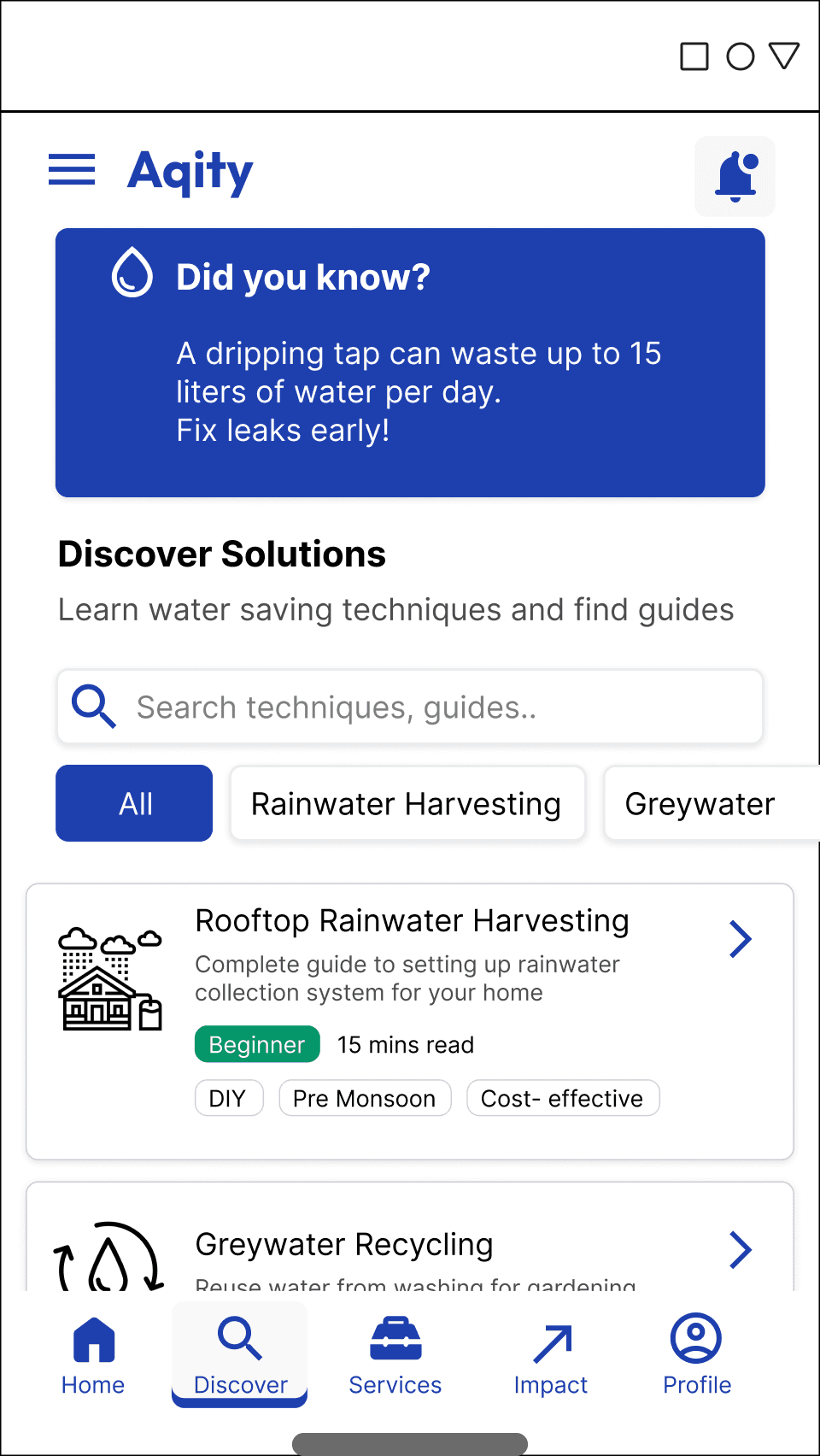
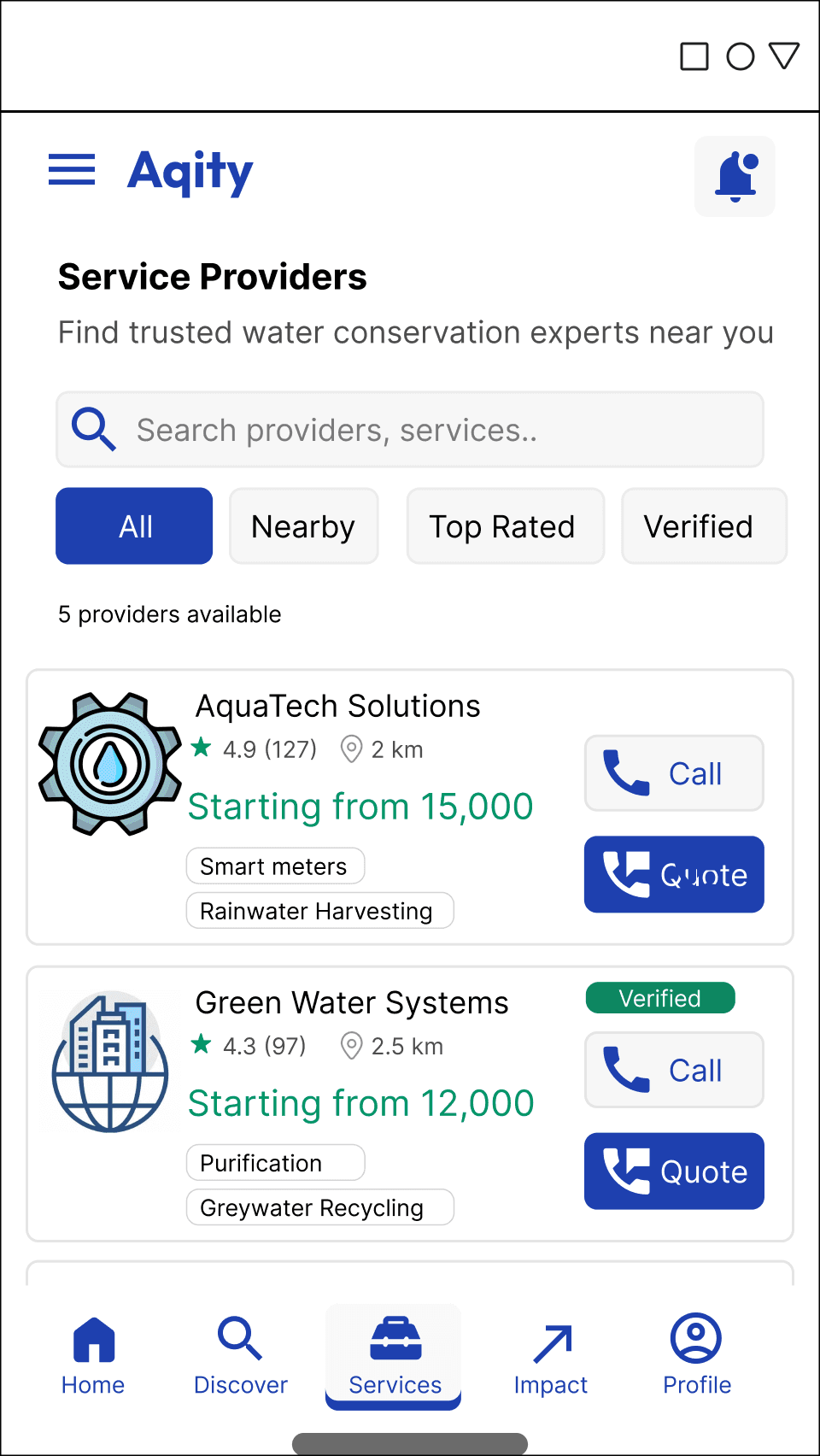
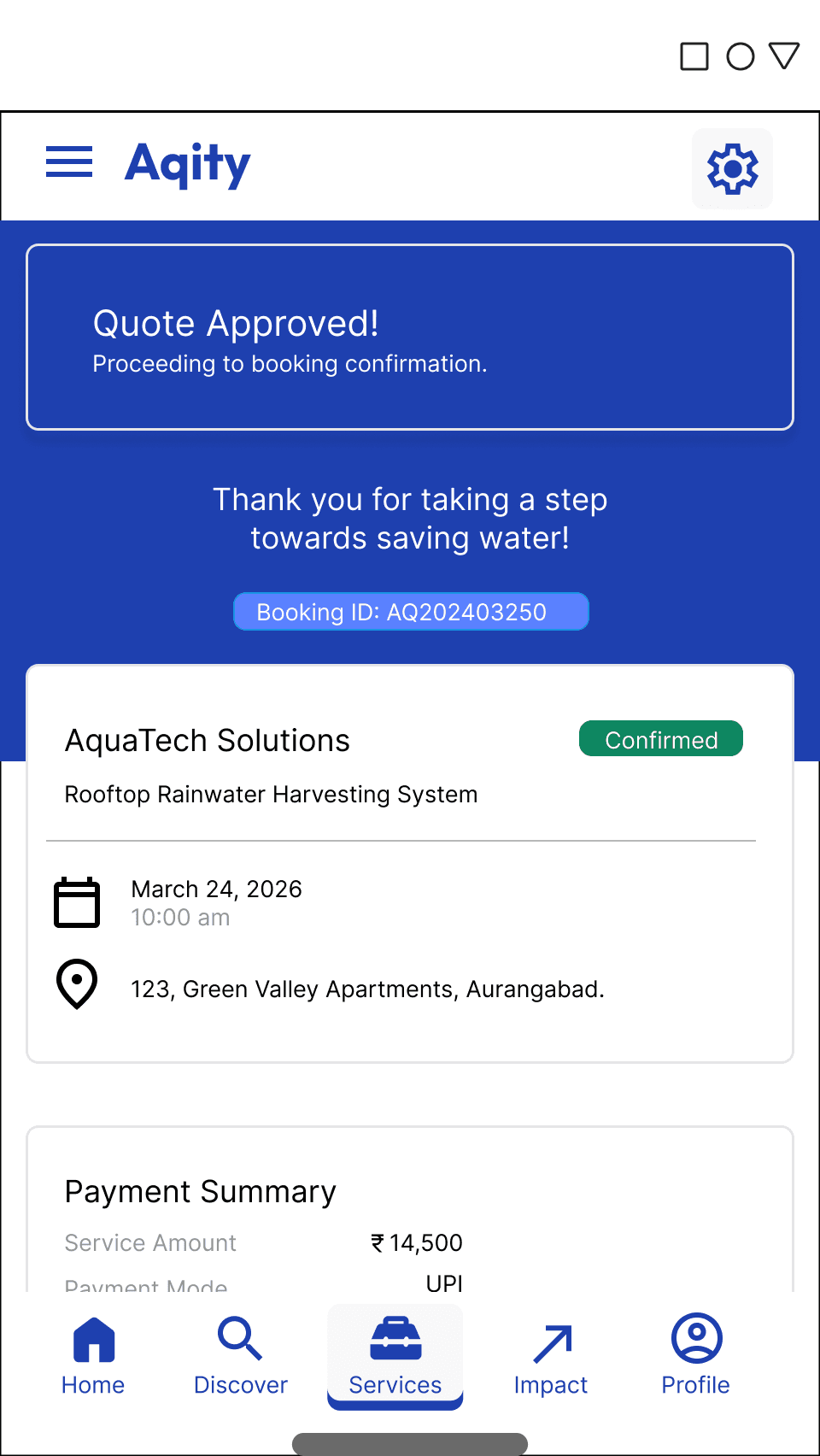
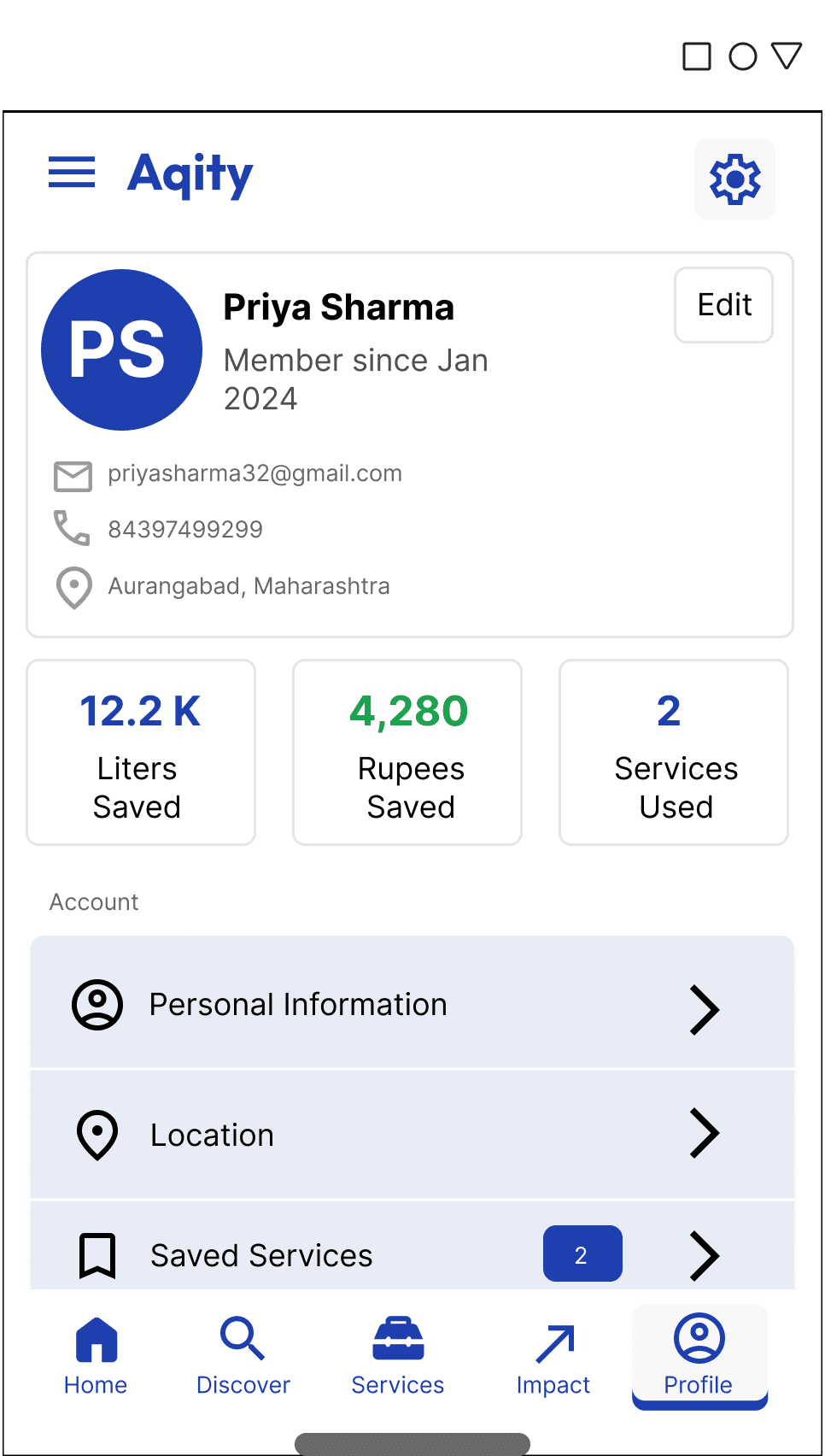
Problem Statement
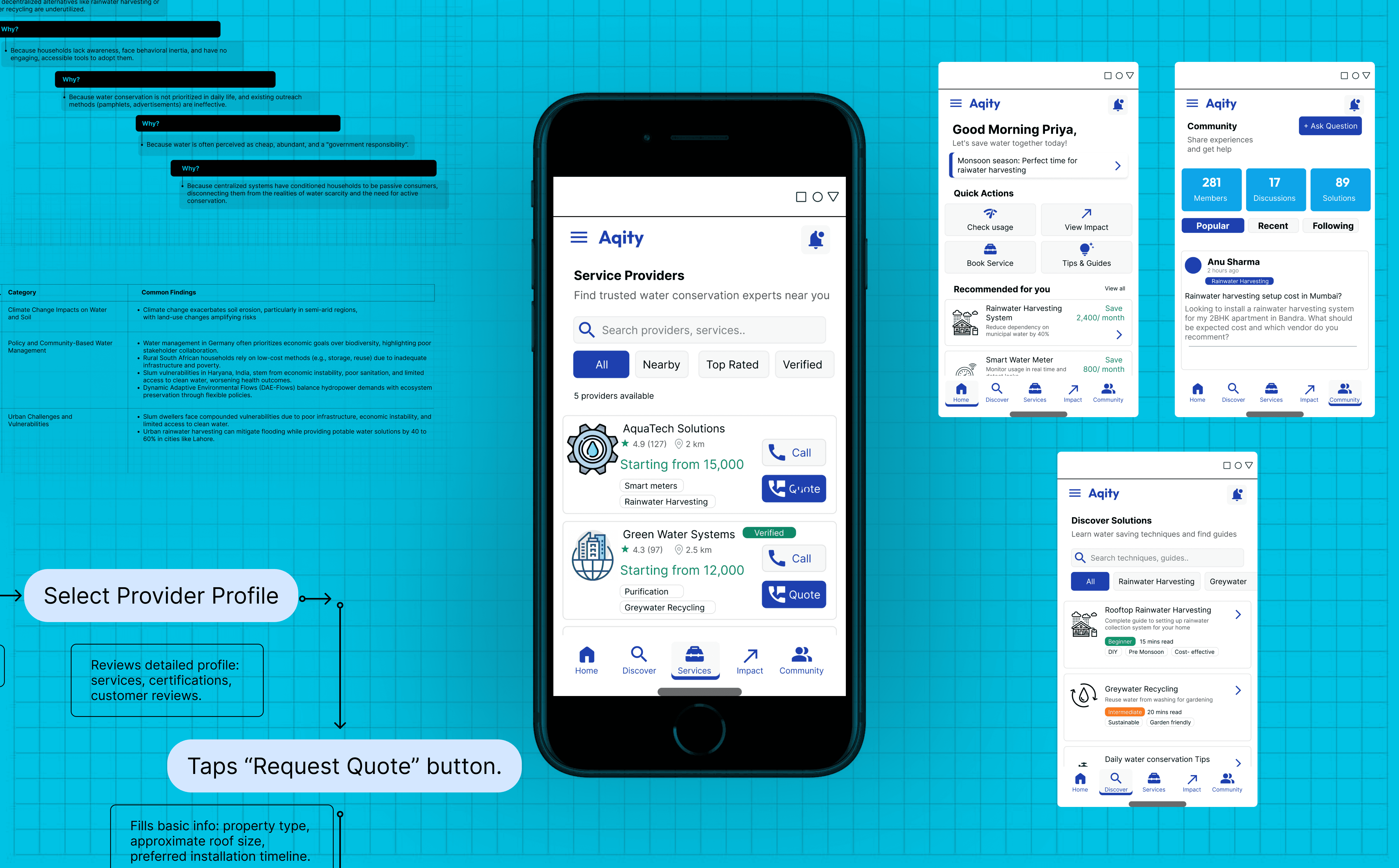
Urban Indian households remain heavily reliant on centralized water supply systems, driven by low awareness, behavioral inertia, and a lack of engaging, accessible tools to adopt decentralized conservation methods. This overdependence intensifies acute water scarcity in rapidly growing cities like Bengaluru, Chennai, and Delhi, threatens sustainable resource management, and undermines efforts toward climate resilience and public health.
In This Section
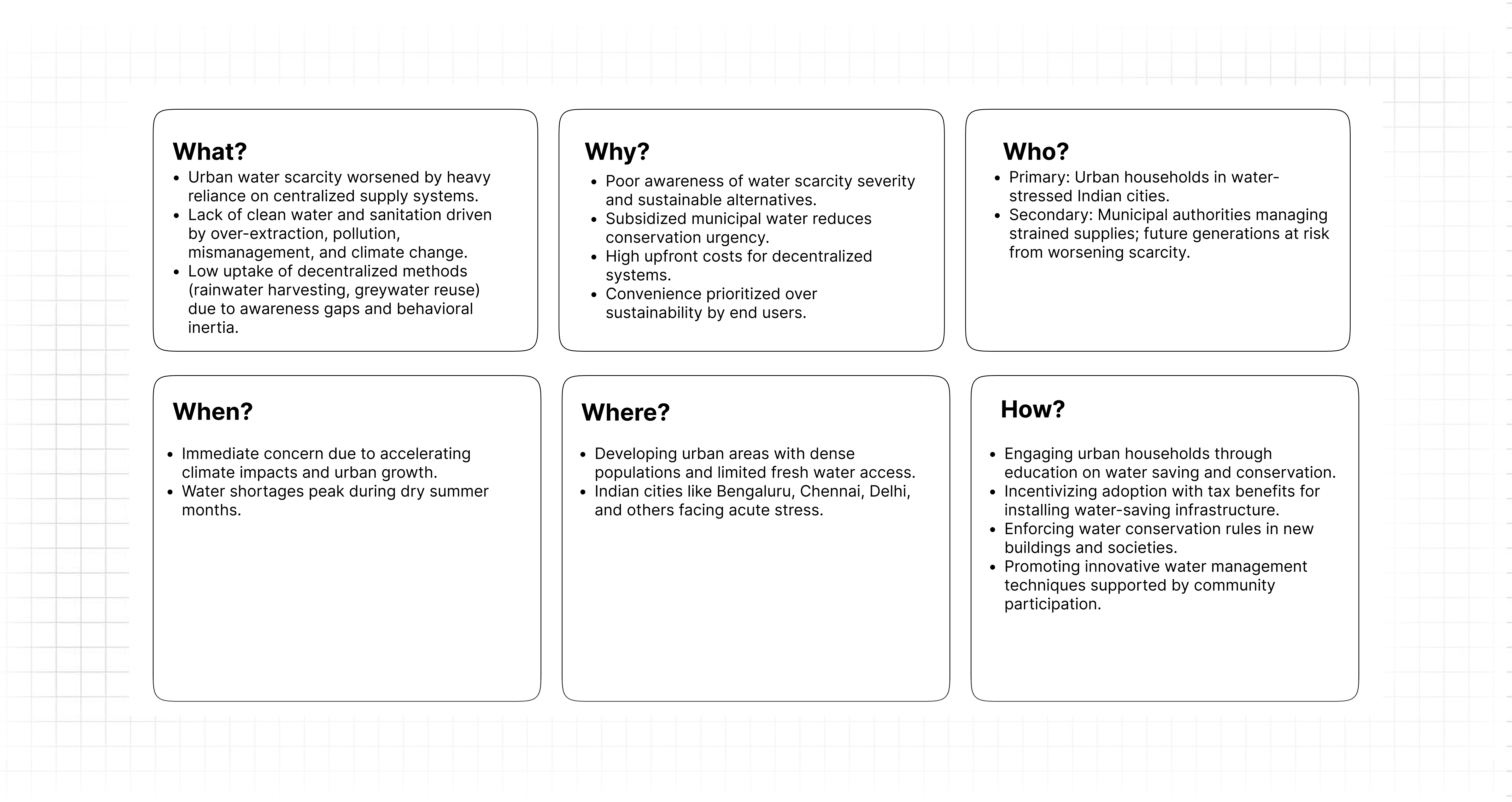
5W1H
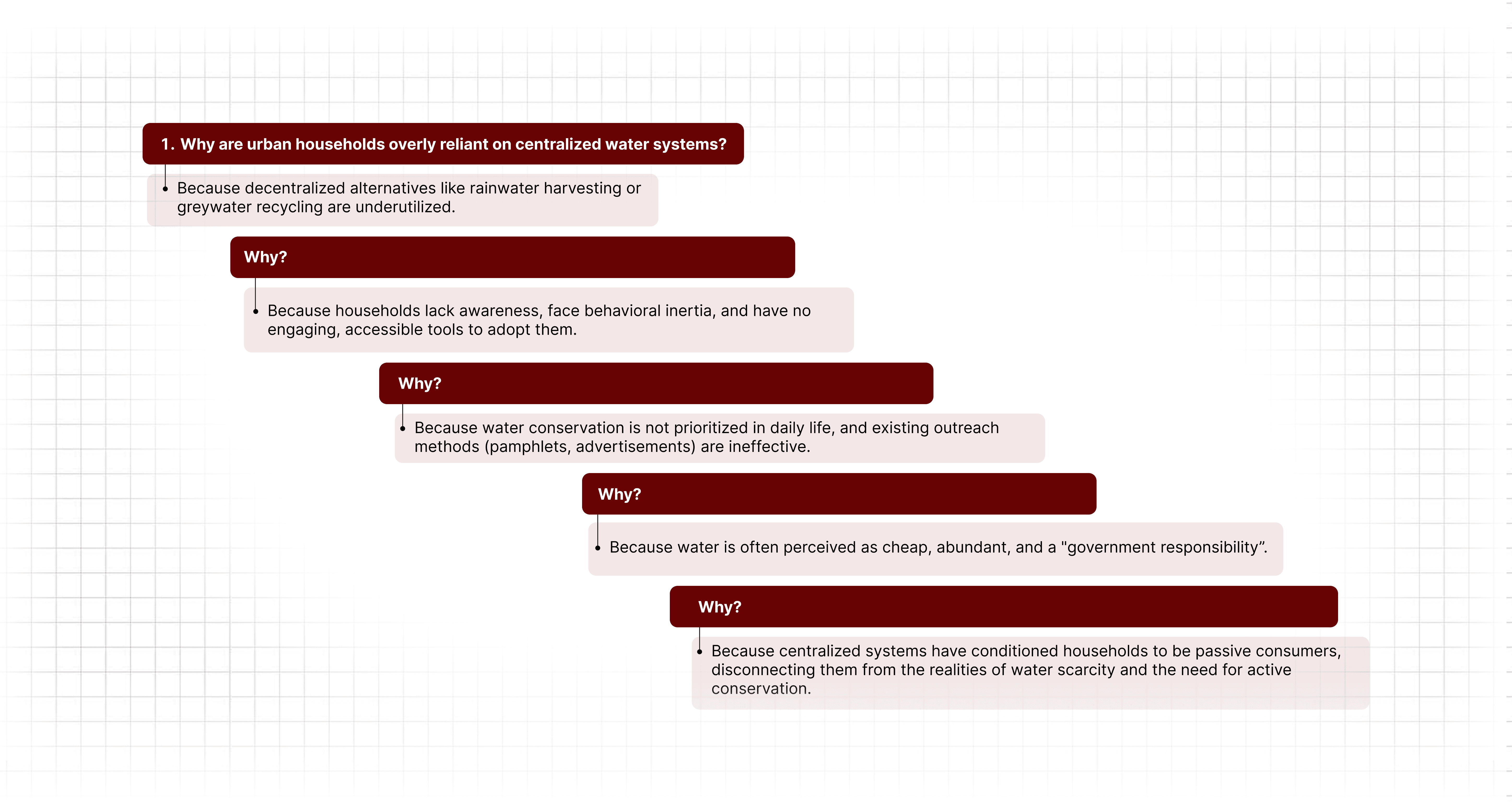
5Whys
Root cause analysis
5W 1H
5 Whys
Root Cause Analysis
Lack of decentralized sources: Urban areas lack accessible rainwater harvesting systems, wells, or greywater reuse infrastructure.
Insufficient incentives: Few subsidies or infrastructure investments to encourage decentralized adoption.
Awareness gaps: Limited education and outreach about household water-saving practices and their cumulative impact.
Behavioral & cultural barriers:
Conservation seen as inconvenient or unnecessary.
Social norms do not strongly promote sustainable usage.
Psychological conditioning fosters trust in centralized supply, disconnecting users from the reality of scarcity.
In this Section
Secondary Research
Primary Research
Building Persona
Secondary Research
After brainstorming and mind mapping, keywords were derived.
Reviewed existing 52 studies, papers and use cases across India and other countries.
These papers published between 2010 – 2024 and were considered for accurate and relevant results.
Some of the case studies introduced new techniques of water conservation in forms of diagrams and images.
To understand these 52 papers, I grouped them in categories
Sr. No. | Category | Common Findings |
|---|---|---|
1 | Climate Change Impacts on Water and Soil |
|
2 | Policy and Community-Based Water Management | Water management in Germany often prioritizes economic goals over biodiversity, highlighting poor stakeholder collaboration.
|
3 | Urban Challenges and Vulnerabilities |
|
4 | Biomimicry and Sustainable Development |
|
5 | Community-Based Water Solutions |
|
6 | Rainwater Harvesting and Water Conservation |
|
Summary
Research highlights that addressing water scarcity and climate impacts effectively requires combining traditional practices with modern technologies tailored to local contexts. Indigenous methods—such as Johads, Jhalaras (step-wells), Taanka pits, and Bamboo drip irrigation—have long sustained water availability in arid Indian regions by harvesting and recharging groundwater. These systems emphasize community participation, cost-effectiveness, and environmental preservation.
Modern innovations, such as GIS mapping, smart rainwater harvesting, greywater recycling, and IoT monitoring, enhance efficiency by optimizing water capture, usage, and maintenance while providing data-driven insights for urban settings.
Balancing policy reforms and stakeholder collaboration enables sustainable governance that aligns economic development with water and biodiversity conservation. Adaptive climate strategies like Dynamic Environmental Flows (DAE-Flows) and dew harvesting further mitigate changing ecosystem stressors.
However, awareness and adoption gaps pose key challenges. Persistent education campaigns, engaging digital platforms, and localized incentives are critical to scaling sustainable practices, especially in densely populated urban areas facing acute water shortages.
This integrated approach underscores the need for context-specific, interdisciplinary solutions that balance ecological health and socioeconomic needs to achieve lasting water security in India.
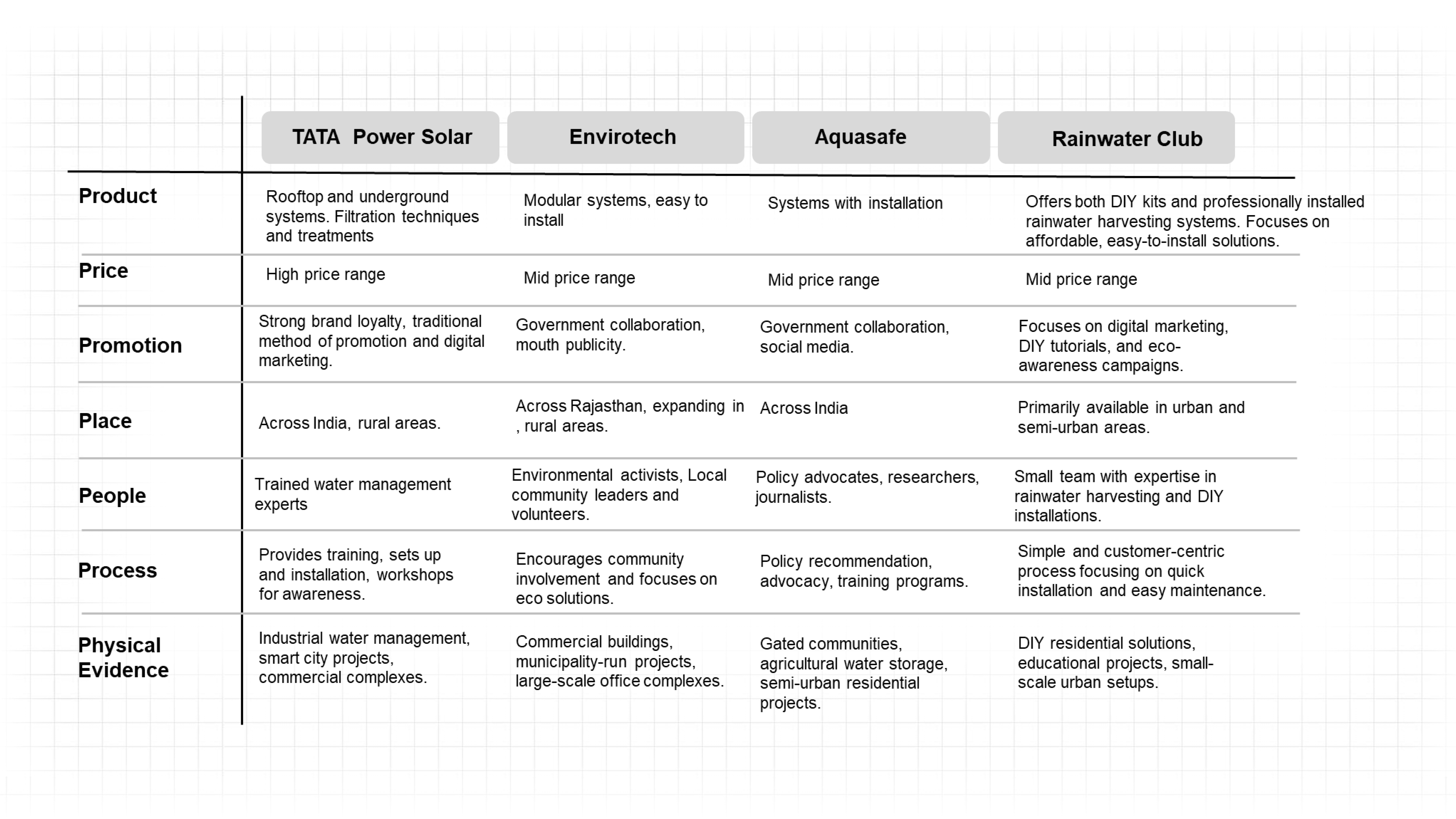
Competitor Analysis
Primary Research
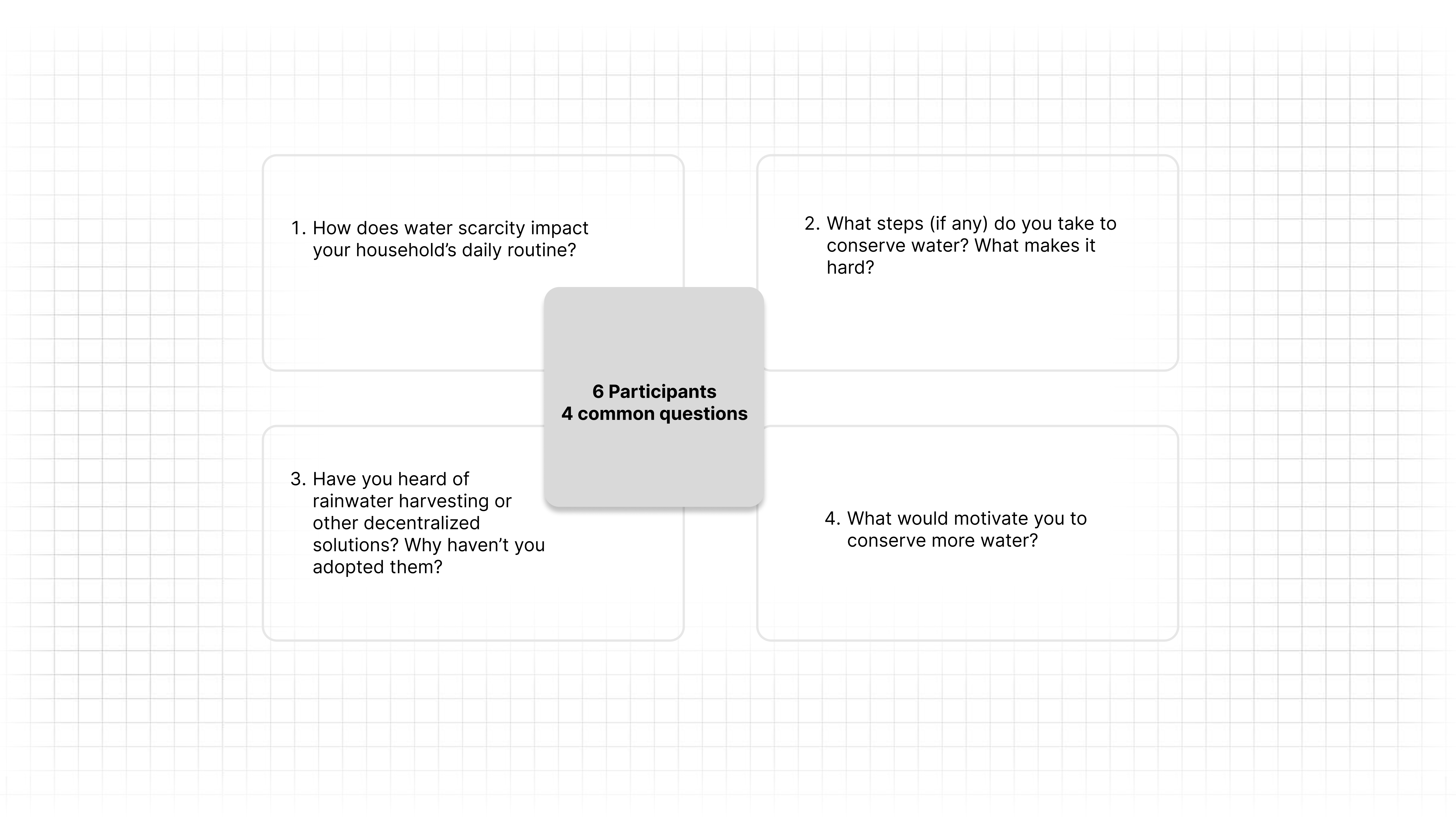
Participants: Surveyed 42 participants and interviewed 6 volunteers.
Method: Google forms for survey and online video meet for interviews. The questions for interview were semi structured, keeping the integral questions same.
Purpose: To understand how urban citizens experience water scarcity, shortage and perceive conservation of water as a responsibility and innovate ways.
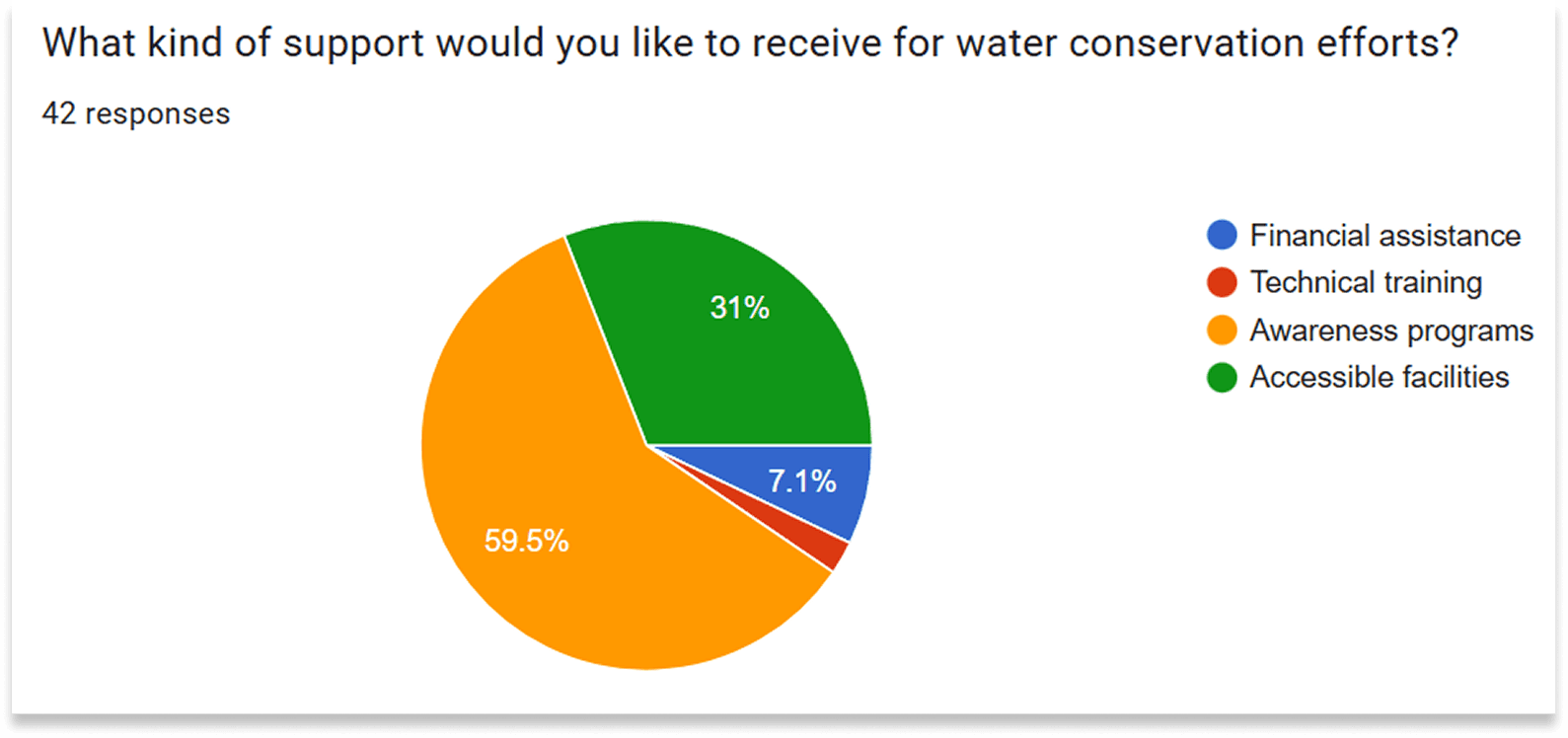
Summary:
Maintaining water resources is challenging due to a lack of awareness, technical expertise, and community support.
There's a strong interest in learning more about preservation and implementing RWH if technical and financial assistance is provided.
Environmental conservation and reduced dependency on external sources are the most associated benefits.
Awareness programs and accessible facilities are the most desired forms of support for water conservation efforts.
Interview
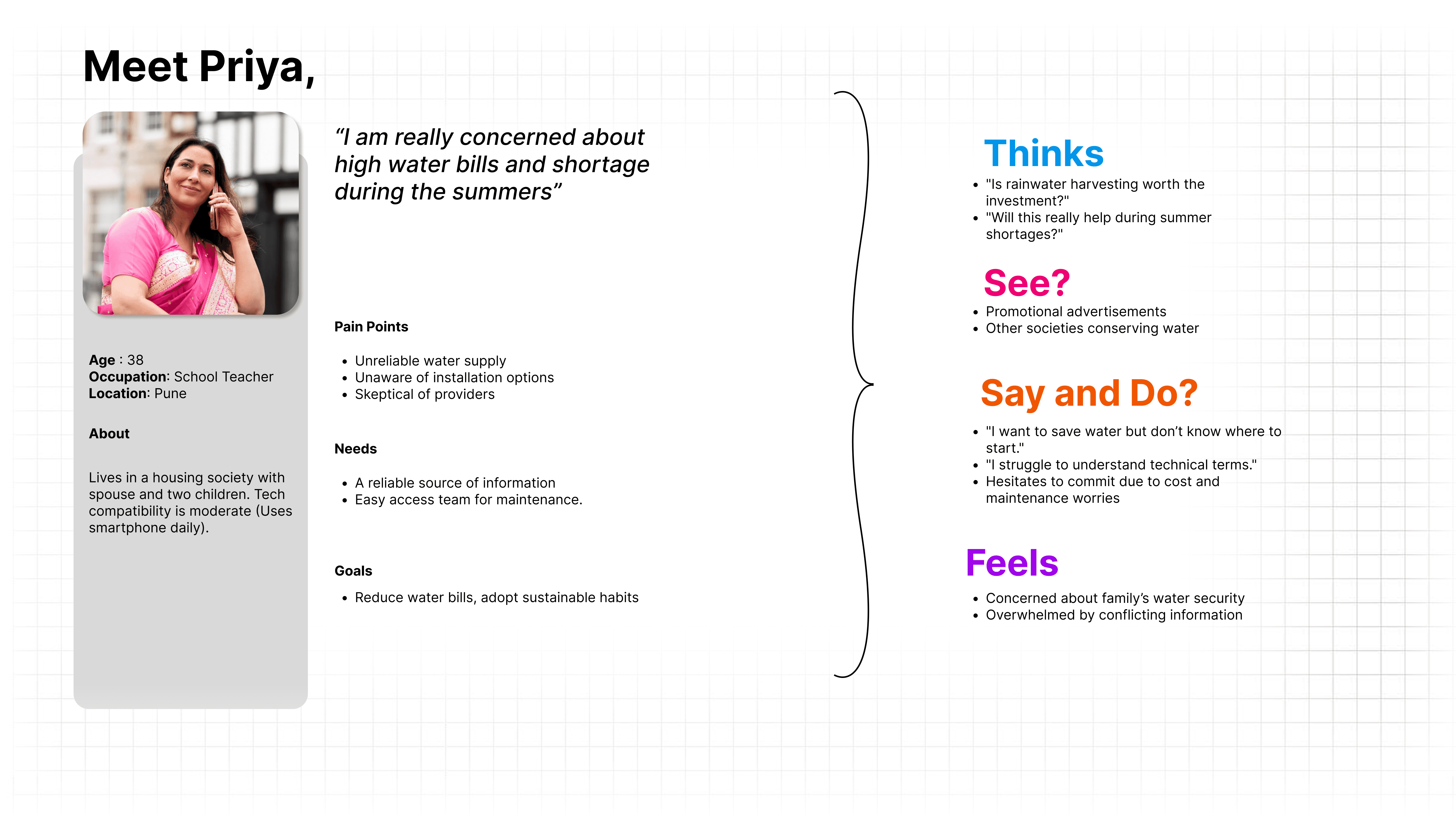
Building Persona
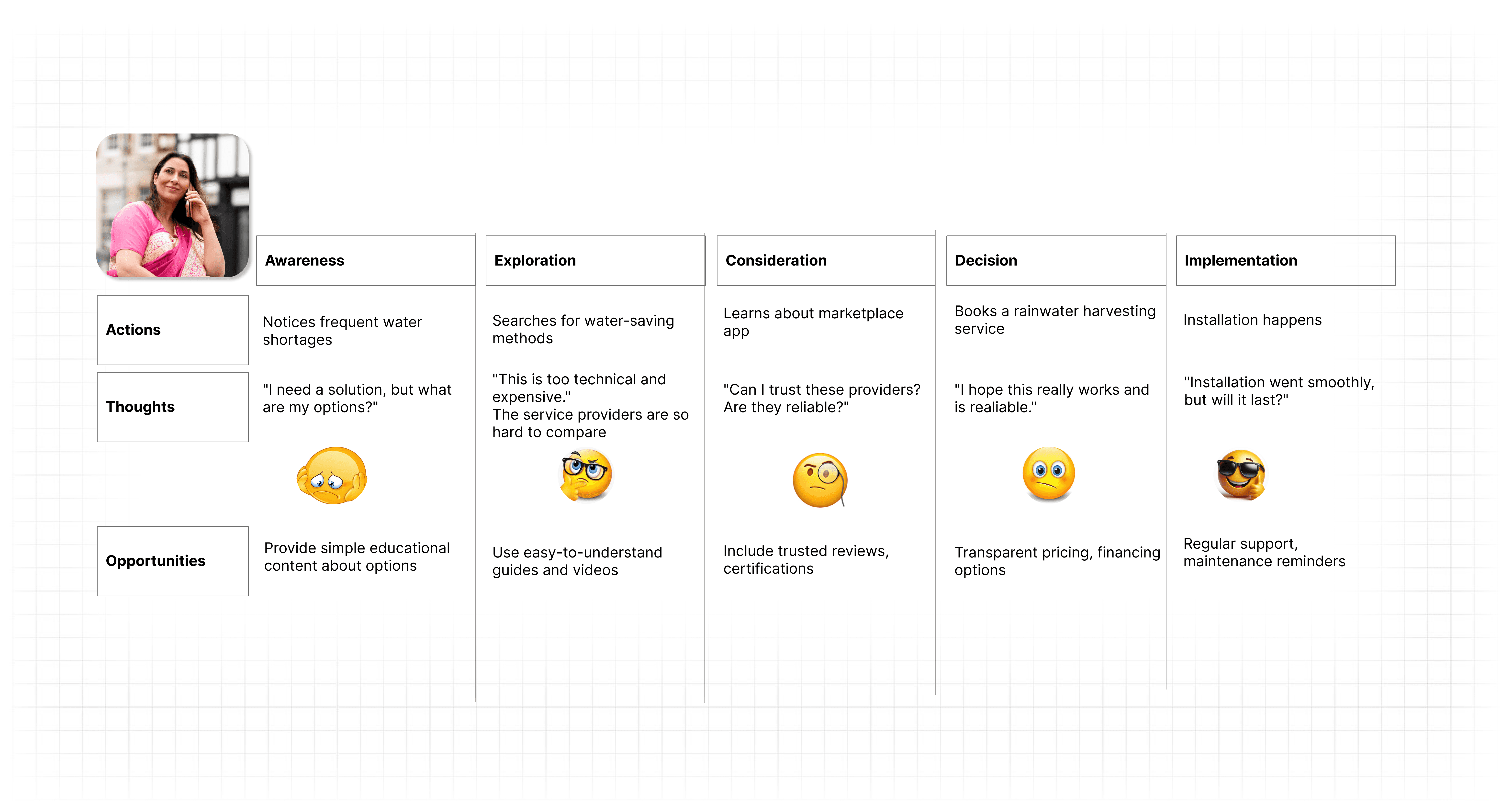
User Journey Map
How might we?
How might we empower urban Indian households to easily discover, understand, and adopt decentralized water conservation practices by connecting them with trusted service providers and engaging educational resources thereby reducing dependency on centralized water systems and alleviating urban water scarcity?
In this Section
Solution Ideation
Feature List
Task analysis
Solution Ideation
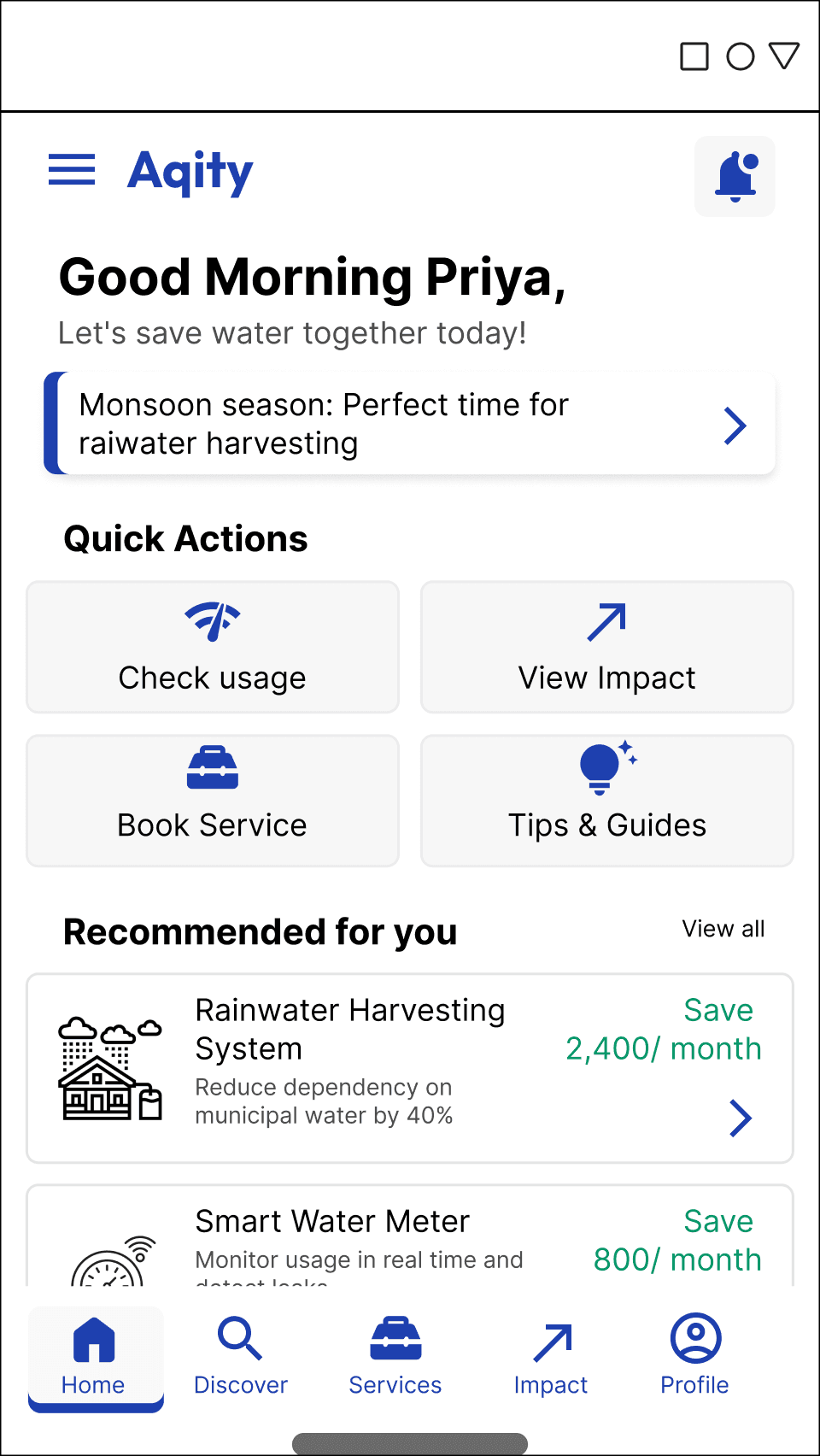
Based on the research insights, user pain points, and market gaps, the solution centers on a digital marketplace app that integrates education, discovery, and service employment focused on decentralized water conservation techniques suited for urban Indian contexts. The core idea is to:
Bridge the knowledge and awareness gap by providing engaging, easy-to-understand educational content and guides.
Facilitate trust and convenience by connecting users to verified providers and installers offering rainwater harvesting, greywater reuse, smart water meters, and related services.
Simplify the adoption process with transparent pricing, financing options, subsidy information, and booking systems.
Track measurable impact to motivate continued adoption and community engagement.
Leverage community forums and peer reviews to build social proof and shared learning.
Feature List
Core Features (MVP)
User Onboarding & Profiling
Role selection (resident, manager, business)
Water usage and concern survey for personalization
Educational Hub
Interactive guides on rainwater harvesting, water-saving tips, greywater
Videos, infographics, FAQs
Subsidy and incentive information updates
Marketplace Directory
Search and filter local providers by service, rating, price, certifications
Provider profiles with photos, services, reviews, contact
Service Booking System
Quote requests
Calendar scheduling
In-app chat with providers
Payment gateway integration (basic)
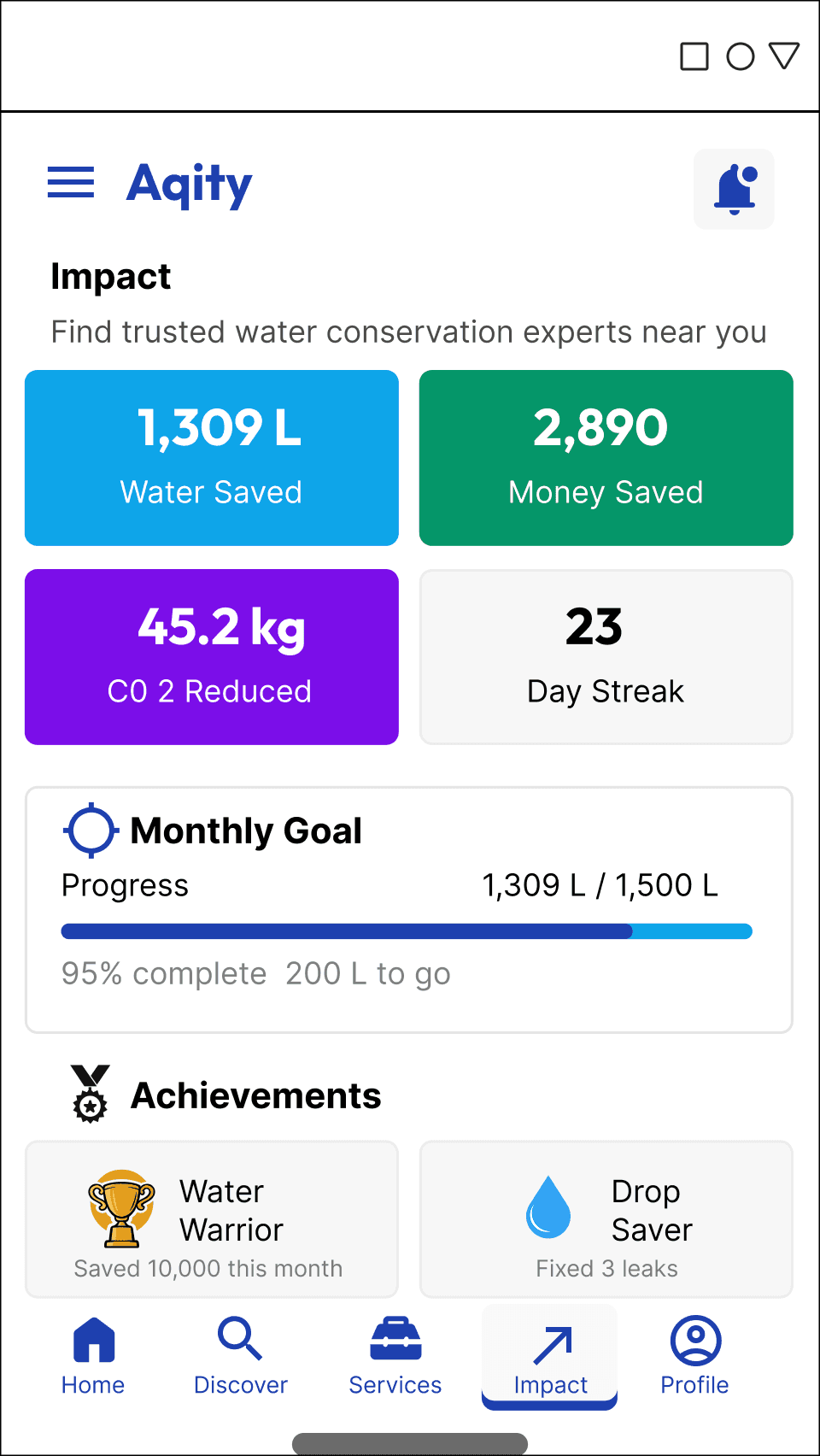
Impact Dashboard
Water saved (liters), money saved, environmental impact stats
Maintenance reminders and tips
Community & Feedback
Q&A forum for sharing experiences and asking questions
User reviews and ratings for providers
Sharing of success stories and water-saving achievements
Notifications & Alerts
Booking confirmations and reminders
Water conservation tips and updates
Task Analysis
Task | Subtaks & Steps |
|---|---|
Sign Up & Personalize Profile | Register with phone/email → Select role → Answer water-related questions |
Learn About Water Conservation | Browse categories → Read/Watch guides → View local subsidy info |
Find Service Providers | Search/filter providers → Read reviews and profiles |
Book a Service | Select provider → Request quote → Schedule installation → Confirm booking |
Monitor Impact | View dashboard stats → Receive reminders → Track savings progress |
Engage with Community | Browse forums → Post questions → Reply/share experiences |
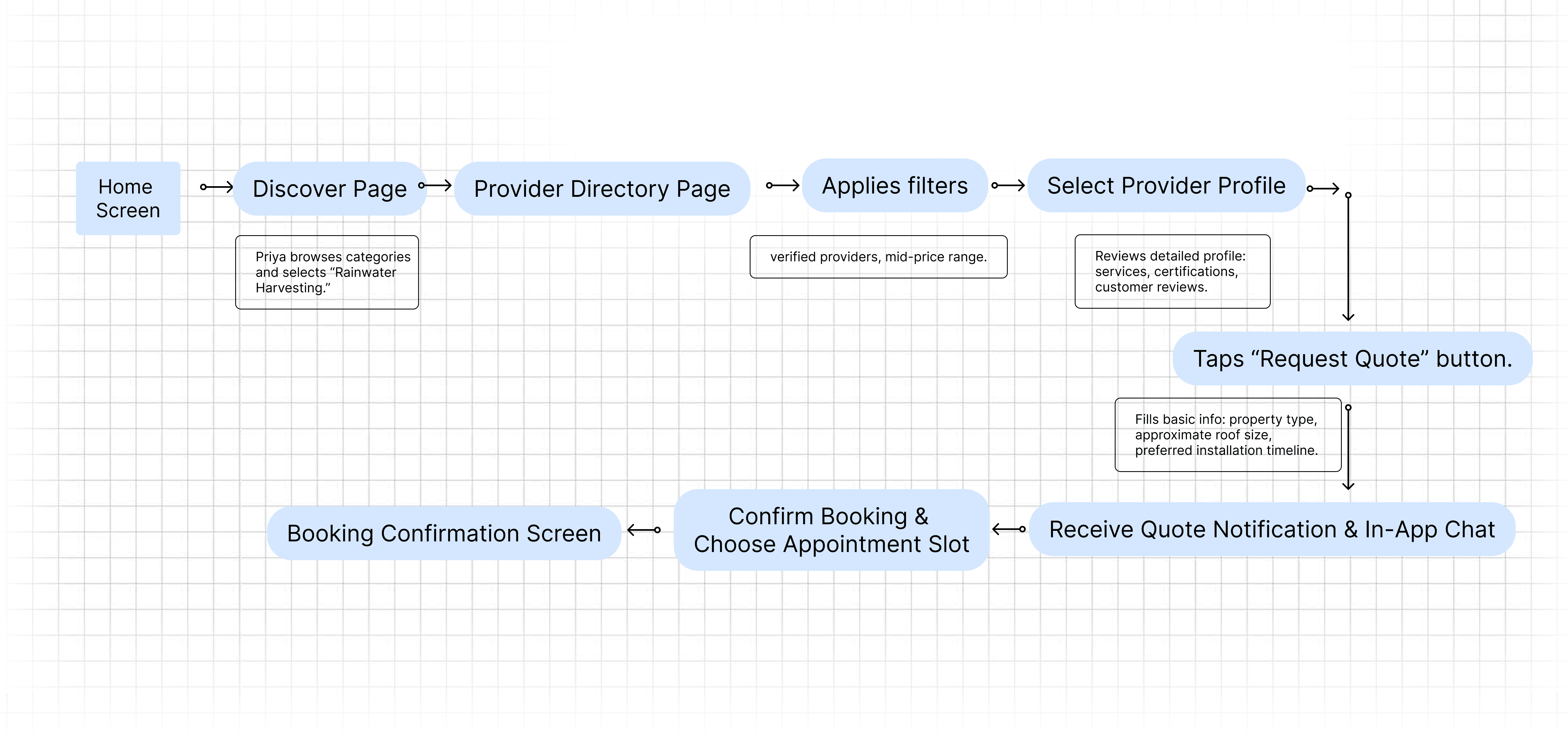
User Flow
Scenario: "Priya uses the app to book a trusted local provider to install a system at her home."
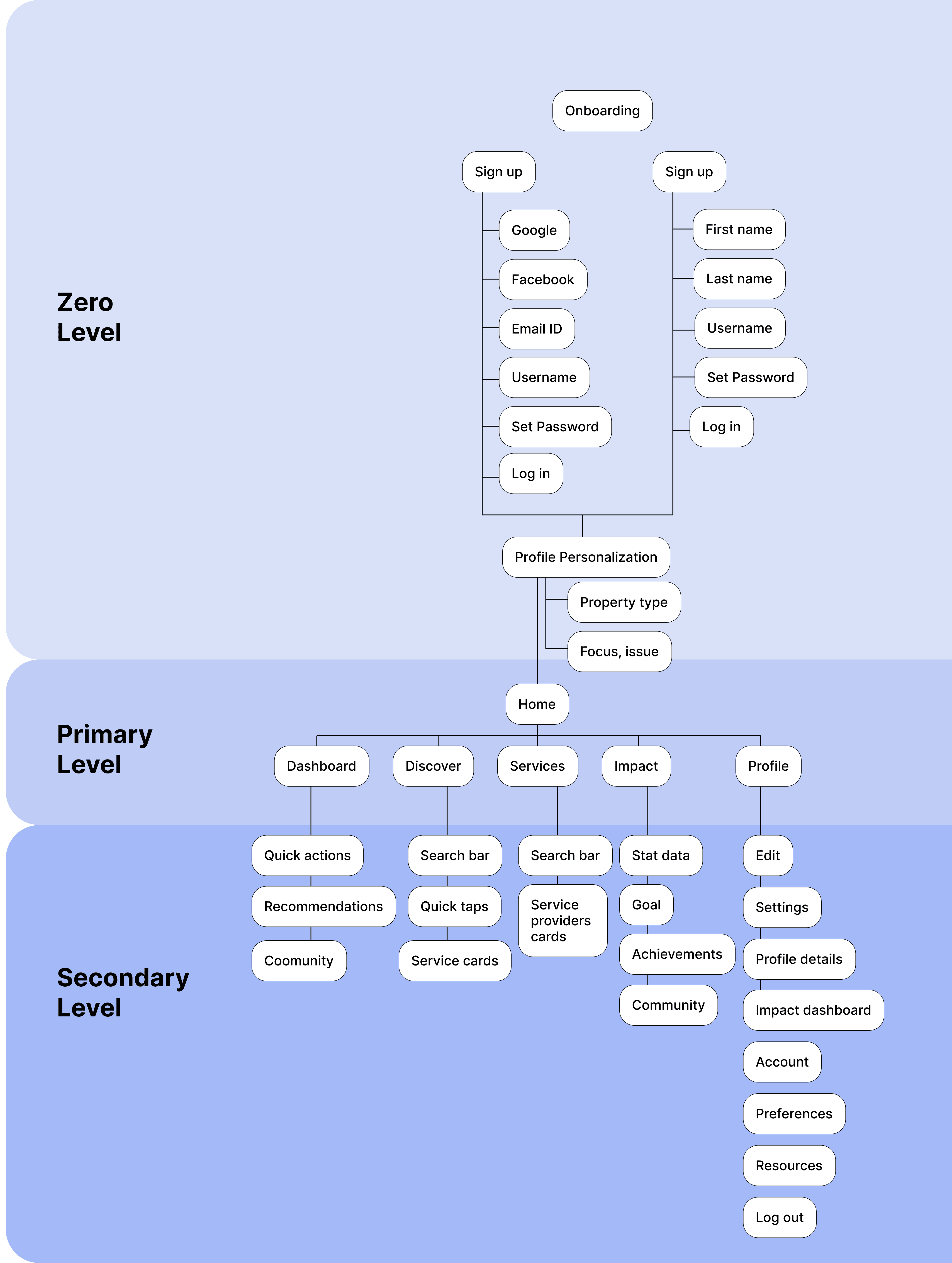
Information Architecture
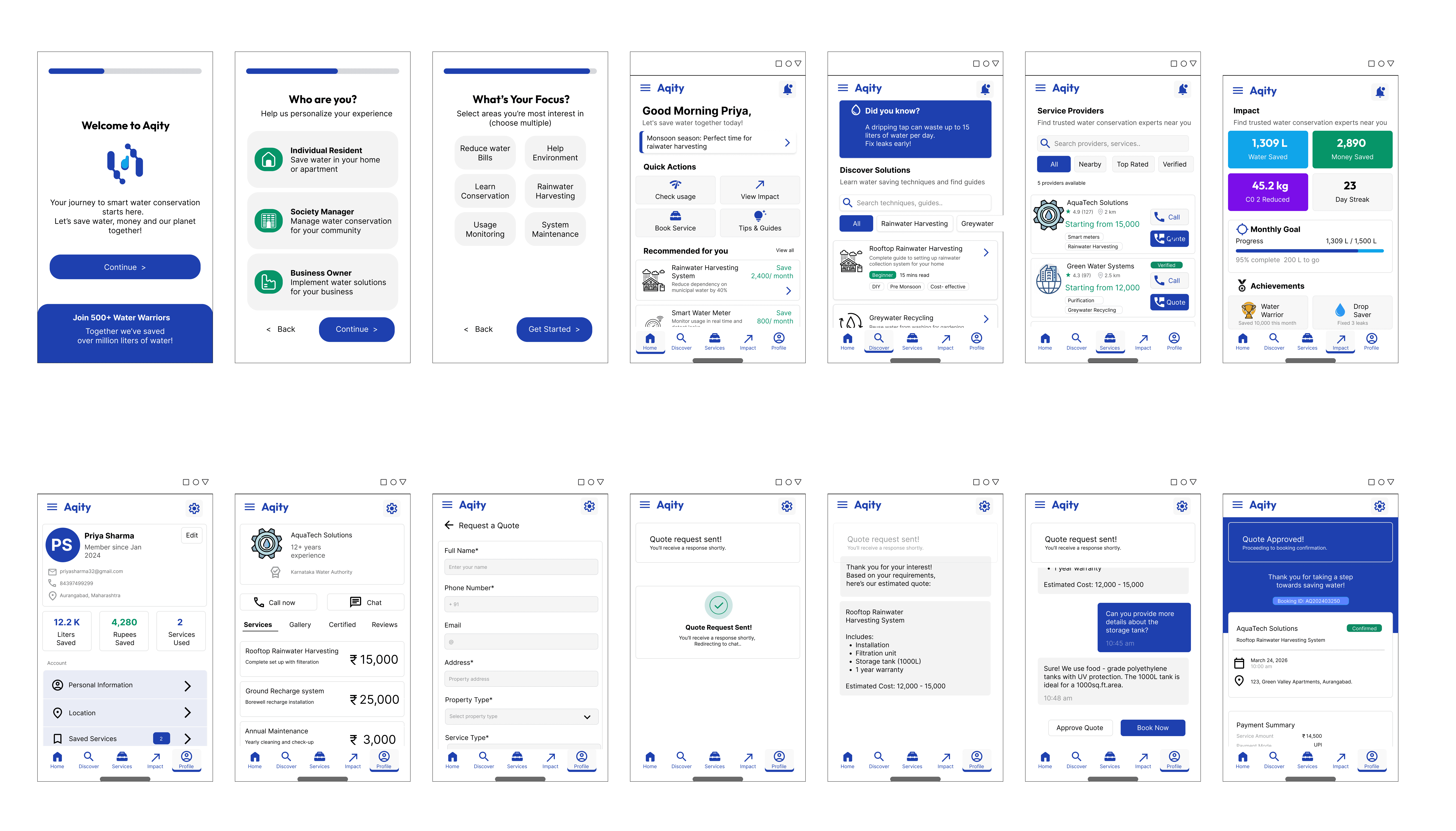
Screens:
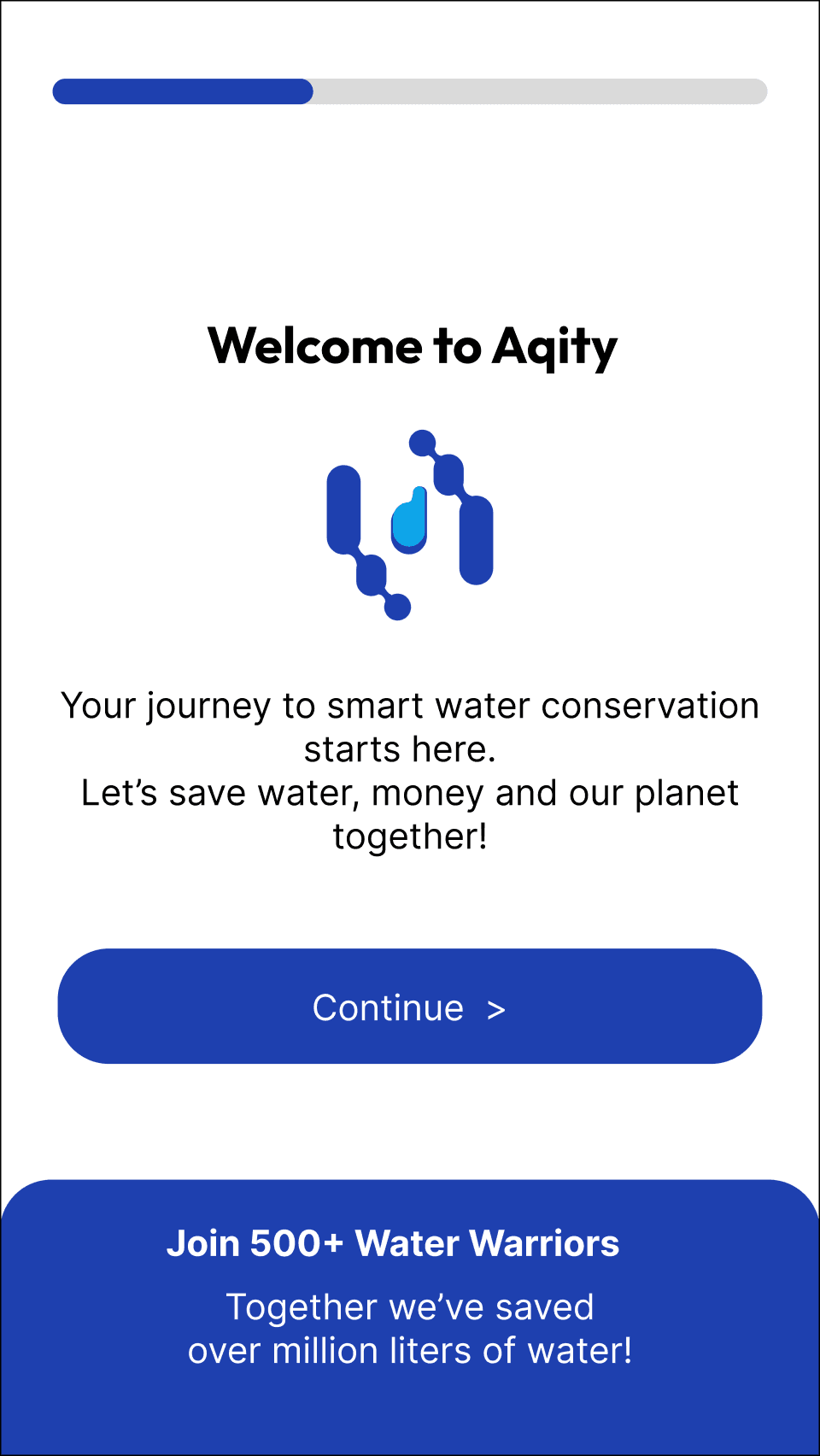
You can interact with the Prototype here:
Learnings
#1 User-Centered Research Is Foundational
Deep, qualitative and quantitative research anchors design decisions in real user needs.
Personas, empathy maps, and journey maps translate complex user behavior into actionable insights.
Iterative user interviews and surveys validate assumptions and refine problem framing.
#2 Defining Clear Problem Statements Drives Focus
Well-articulated problem statements crystallize the challenge and guide ideation.
Clarity in problem scope helps prioritize features with maximum user impact.
#3 Design is Both Creative and Systematic
Effective UI/UX design blends aesthetic appeal with usability and accessibility.
Wireframes and prototypes progressively evolve - from low to high fidelity - with continuous validation.
Visual hierarchy, clear CTAs, and language simplicity enhance user engagement, especially for diverse age groups and tech comfort levels.